A PhD student co-funded by Logogramma, in collaboration with the PRISCA LAB of the University of Naples Federico II, has participated in a study conducted with the Miroka robot. Together, they demonstrate how conversational AI can make human-robot interaction more context-aware and socially appropriate.
How can a robot understand not only what a person asks it to do, but also whether it is appropriate to do so in a given situation?
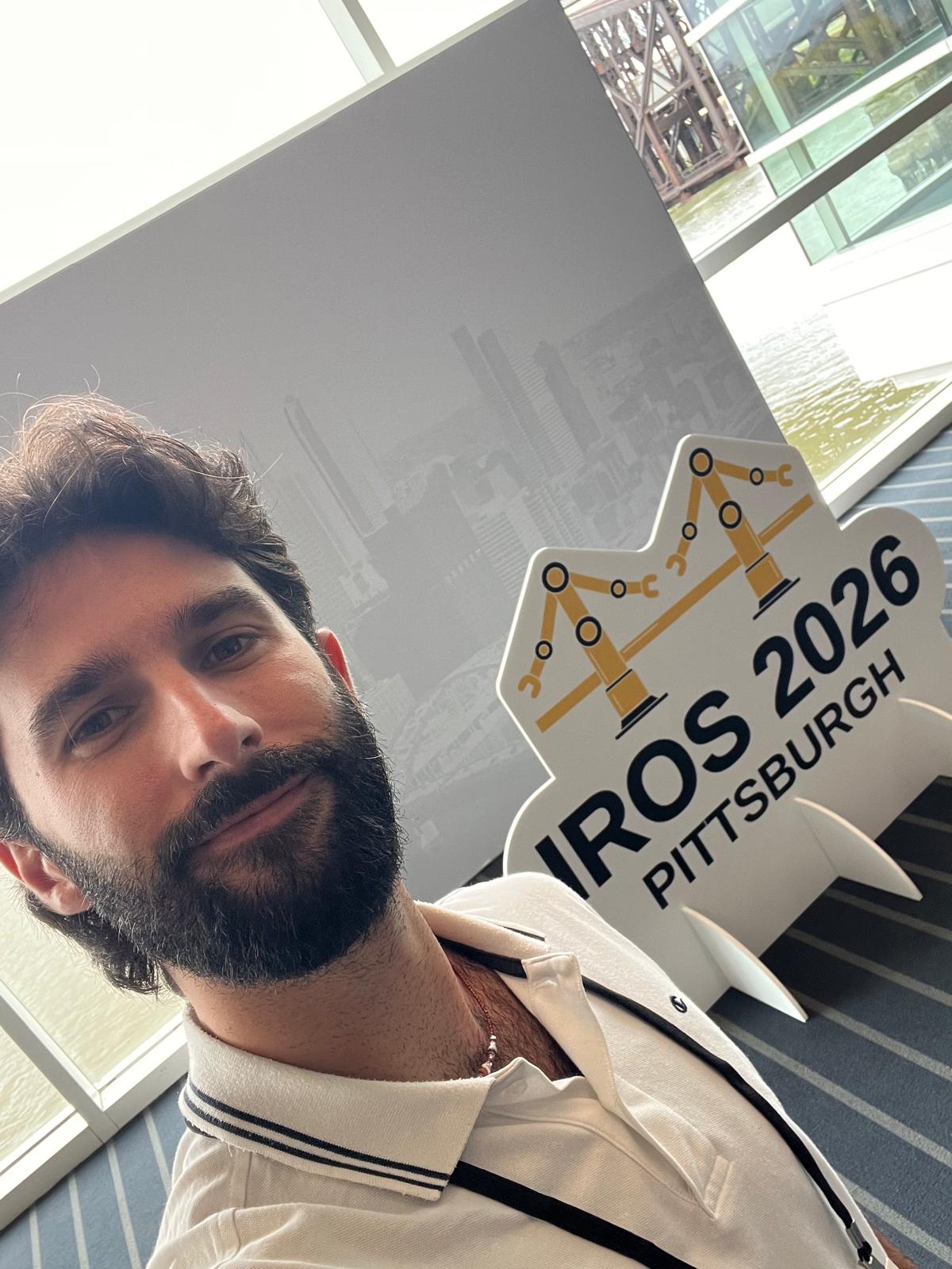
This question was at the heart of our participation in IROS 2026 — the IEEE/RSJ International Conference on Intelligent Robots and Systems, held in Pittsburgh, United States.
Mario Barbato, whose PhD research is co-funded by Logogramma, presented the paper “That Is Not Appropriate! A Multimodal Architecture for Context-Aware Skill Execution in Social Robots”, produced in collaboration with Silvia Rossi (Director of PRISCA LAB UNINA) and Valentina Russo (CEO of Logogramma). The contribution was presented during the session “Context-Aware Multimodal Interaction for Robots”.
Beyond commands: understanding the context
Natural language interaction is a fundamental component of social robotics. However, understanding a command is not always enough: a robot must also interpret the circumstances in which a request is made and take into account the people involved and the social dynamics.
The research addresses this challenge through a modular architecture that combines a structured ontology of the robot’s skills, multimodal reasoning, and identity recognition. Natural language commands, together with visual and interpersonal cues, help the system evaluate whether the execution of a specific skill is appropriate in a specific context and moment.
The architecture was evaluated through an experimental study with 54 participants, who interacted with the Miroka robot. The results confirm the importance of integrating explicit contextual reasoning mechanisms into the decision-making architectures of social robots.
Linking academic research to market innovation
For Logogramma, this work represents much more than a scientific contribution. It is a concrete example of the value of a continuous connection between academic research and the development of innovative solutions for high-impact real-world applications.
By co-funding doctoral research programmes and collaborating with researchers, scholars, and Research Centres, Logogramma helps create the conditions for scientific ideas to be explored, tested, and validated. This allows them to be transformed into new technological capabilities, bringing research results closer to the concrete needs of organisations, users, and the market.
The collaboration with UNINA is part of this broader commitment: fostering dialogue between scientific expertise and the needs of the business world to develop AI systems that are not only technologically advanced but also useful, adaptive, and designed around interaction with people.
Conversational AI beyond screens
The study conducted with Miroka also highlights a core capability of Logogramma’s technology: the integration of conversational AI into very different devices and interaction contexts.
Thanks to the AI.CODIUM® platform — and its modules and features — we are able to make natural language interaction available wherever it can generate value, without tying the capabilities of artificial intelligence to a single interface or hardware platform.
In the field of robotics, this means integrating language understanding and contextual reasoning with the operational capabilities of a physical system, helping the robot move beyond the simple execution of commands to develop more adaptive and socially context-aware interactions.
Application-oriented research
At Logogramma, research and product development are closely linked. Scientific collaborations, research funding, and experimentation form the basis for exploring new capabilities, while concrete applications allow us to identify the fundamental requirements for their adoption.