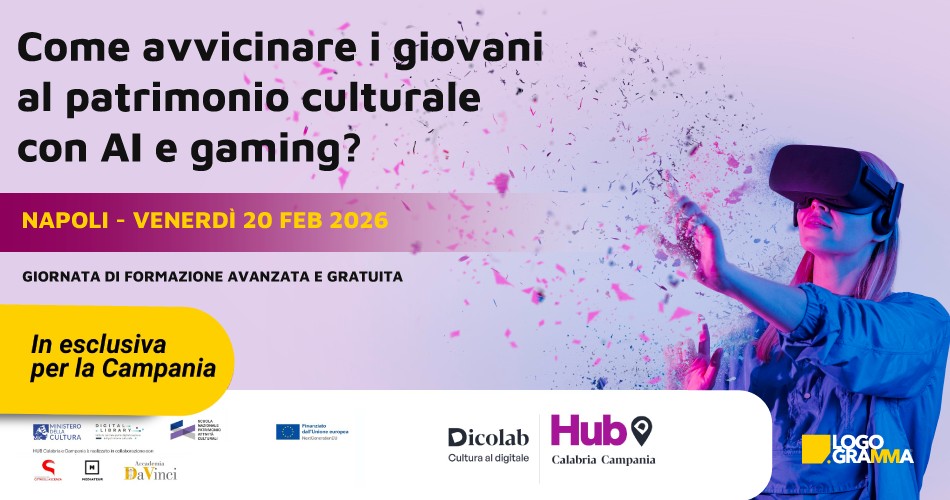
Friday 20 February, as part of the DicoLAB 2026 courses of the Calabria Campania HUB – managed by Fondazione Idis Città della Scienza, Mediateur and Accademia Da Vinci – Logogramma will hold two courses focused on the themes of the digital transition in the cultural heritage sector.
Starting from our solutions created for cultural heritage thanks to the AI.CODIUM® platform – VISIT3D and The VISIT Game – it will be possible to show how AI and innovative technologies can be exploited to make our vast artistic and cultural heritage more accessible and engaging.
Our PhDs Azzurra Mancini and Marco Grazioso will hold two Level I certified training courses dedicated to those who work daily, in various capacities, in the conservation, protection, management, and promotion of cultural heritage, in museums, archives, libraries, and places of culture.
How do you participate in the DicoLAB 2026 courses?
To participate in the courses it is necessary to register via the dedicated Campania Calabria HUB page available here: dicolab.it/hub/hub-calabria-campania.
By scrolling to the bottom of the page, it will be possible to discover and book all available courses, including those we will hold on Friday 20 February. We remind you that these training sessions are certified and free, but availability is subject to remaining places.
The courses are part of the “Dicolab. Cultura al digitale” training offer, an initiative of the Ministry of Culture, Digital Library, and the National School of Cultural Heritage and Activities, funded by Next Generation EU.
AI and innovative technologies for immersive cultural experiences (20 February, from 10:00)
The course explores the potential of advanced technologies for the creation of immersive experiences for the enjoyment of cultural heritage, highlighting the contribution of AI and Natural Language Processing in making these methods more accessible and engaging.
Through an overview of their applications within Extended Reality tools and platforms, participants learn how to make the interactive experience as natural as possible, increasing effectiveness in terms of visitor engagement, both on-site and remotely.
Finally, through case studies and practical demonstrations, the course offers a comparison of the technologies available on the market – both proprietary and open source.
AI for edutainment in cultural heritage (20 February, from 14:00)
The second course explores the potential of advanced technologies to create innovative edutainment experiences in cultural heritage, starting from the practical, first-hand use of The VISIT Game platform.
The platform, made available during the course, allows for the exploration of an advanced solution in which AI, Natural Language Processing, and augmented reality make cultural heritage accessible in an interactive and playful way.
Furthermore, several case studies and practical experiences are presented that combine natural language, gaming, and virtual interaction to bring the public, particularly young people, closer to artistic and cultural heritage.